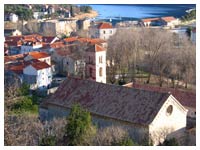
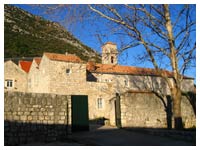
The Franciscan monastery of St. Nicolas in Ston is one of the largest in southern Croatia. The construction of the church started in 1323, in simply roman-gothic style, sparsely decorated while its bells are decorated in the spirit of the XV century, when it was finished.
The church owns a painting of the crucifix that the brotherhood of the citizens ordered from Blaz Jurjev from Trogir in 1323, a leading master of Dalmatian painting school.
 |
 |
 |
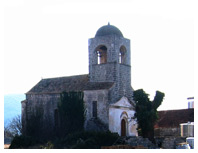
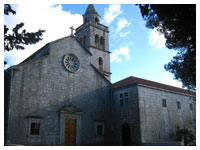
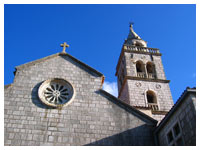
The Church of the Lady of Luzine is built in the salt fields and is one of the two preserved (out of the original eight) churches in the area of Ston and the Ston fields. This church used to be the center of the medieval parish. It is characterized by its roman-gothic style with sharp oval ceiling. Its bell is massive in baroque style with turret on the top.
Next to the church is the monastery building, turned into the salt storage and wine cellars, and the church contains frescoes in rustically baroque style.
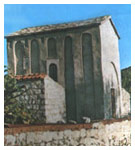
The Church of St. Michael is on the Gradac hill near Ston. This single isle building used to have a dome typical of old Croatian chapels. There are the remains of the frescoes dated from the end of the XI century. The most famous one is a figure of a ruler, most likely Mihajlo Visevic from the X century. It is believed that he commissioned the construction of the church, and his estate was next to the church.
Next to this church is a little monastery of the Dominican sisters, protectors of the church.
 |
 |
 |
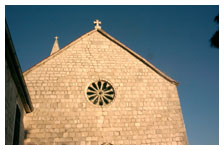
The Church Delorita. Since the end of the XVII century this church is a Peljesac pilgrim's meka, it celebrates the memory of the Lady's house from Loret. Three- isled basilica was built with the donations of the people, and a Franciscan monastery was built next to it. This church is the most monumental baroque style building of this area, outside of Dubrovnik.
The inside of the church was built by the same masters who had built the baroque Dubrovnik cathedral.
Besides several church altars, the Franciscans own the collection of artifacts, liturgical dishes and the collection of paintings by Celestin Medovic.
 |
 |
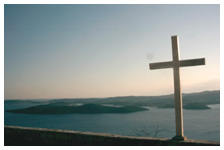 |
Franciscan Monastery and the Lady of Angels. Built high in the hills above Orebic, in the XV century. The church was built with the help of the Republic, in gothic style and according to the Franciscan rules.
This is the prayer church of the seamen with valuable artifacts and paintings such as Madonna by Nikola Firentinac. The main altar best paintings are believed to be by Maffeo of Verona. The large wood crucifix from the XV century is the work of Juraj Petrovic of Split. Until 1950 it had been in a church in Badija near Korcula.
Next to the church is the graveyard of the Peljesac seamen with the typical graves of the XIX century, among which there are some artistically made. The most prominent is the chapel of Mimbelli family with romantic-symbolic statue by Dalmatian sculptor Ivan Rendic.
The legend says that the Orebic captains and seamen greeted the Lady of Angels during their departures and arrivals, with gratitude and asking for protection, while the Franciscans would respond with the bells tolling.
There are still sirens heard from the ships passing through the Peljesac channel, greeting the church of their patron and the resting place of the old captains.
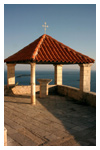
There is a viewpoint in front of the monastery overlooking the Peljesac channel with tiny islets and the city of Korcula.